2,600 years ago: Thales and the olive presses
Before exchanges, screens and formulas, a Greek philosopher made a fortune with a simple idea: pay a little today for the right, not the obligation, to profit tomorrow. That is the idea of an option.
The story
Miletus, a Greek city on the coast of present-day Turkey, around 600 BC. Thales, philosopher and astronomer, is mocked: what good is philosophy if it doesn't put food on the table?
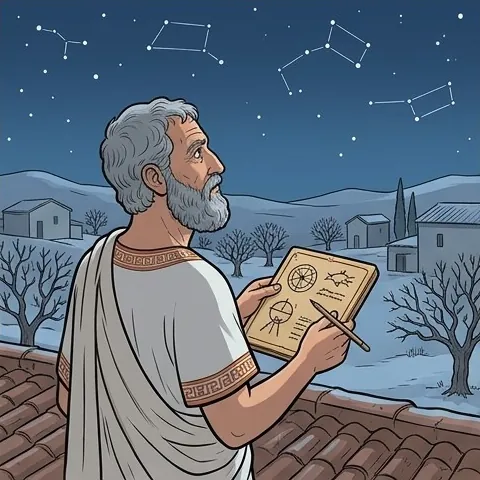
From his observations of the sky, he foresees in winter an exceptional olive harvest for the coming year.
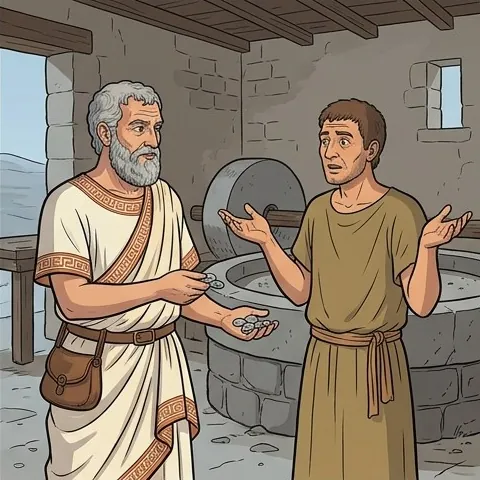
He then pays small deposits to reserve, at a rent agreed in advance, all the olive presses of Miletus and the nearby island of Chios. In winter nobody wants them: he gets them for next to nothing.
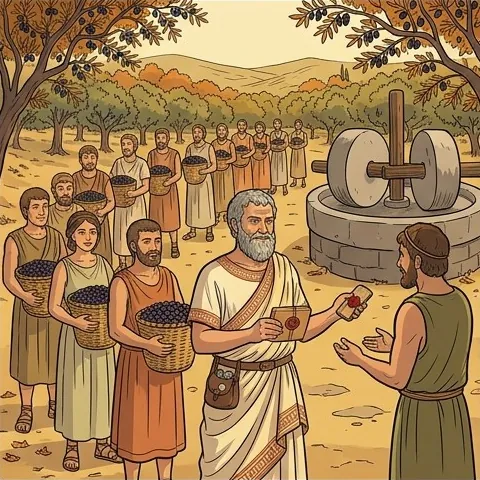
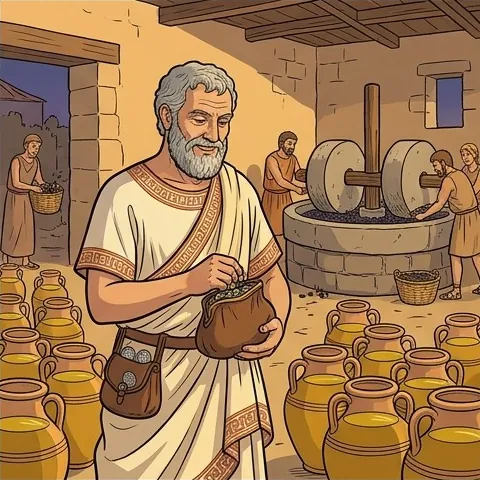
At harvest time, everyone needs a press at once. Thales sublets them at whatever price he likes and makes a lot of money. He shows that philosophers could easily get rich, if that were what they cared about.
And if the harvest had been poor? He wouldn't have rented the presses. He would have lost his deposits, and nothing more.
Replay Thales's bet
interactiveThales reserves 20 presses. Deposit: 5 drachmas per press, 100 in total. Agreed rent: 20 drachmas. Pick the harvest, or move the rent everyone is willing to pay in autumn, and see his result.
What Thales really bought
Each piece of his bet has a name in the vocabulary of options:
In a way, Thales bought a call: the right to use something at a fixed price, profitable only if its value rises above that price. The owners played the seller: a sure income (the deposit), but they left the big gain to Thales. That is the role today's option seller plays.
The word "option"
It comes from the Latin optio, "choice", from optare, "to choose". That says it all: the buyer has the choice, the seller has the obligation. For the Romans, an optio was also a military rank: the deputy chosen by the centurion.
What came next
- Antiquity · Contracts resembling options are said to have existed among the Phoenicians and Romans, on ship cargoes. It is an often-repeated tradition, poorly documented.
- 1636–1637 · In Holland, during "tulip mania", people traded forward contracts and option-like contracts on tulip bulbs, before prices collapsed.
- 1973 · The first exchange for standardized options (the CBOE) opens in Chicago. The same year the Black-Scholes formula is published, the one OptionShaker's calculator uses.
History or legend?
The story comes from Aristotle (Politics, Book I), written about 250 years after the events. Aristotle saw it as a lesson about monopoly, not finance: calling it an "option" is our modern reading.
The Greek text speaks of arrabôn, deposits: reservations, not contracts that could be resold. Cicero tells another version, in which Thales buys the harvest in advance. And archaeology has not confirmed that so many presses existed in Miletus at the time.
What matters is not the accuracy of the tale but the idea it illustrates: paying a little for a right, with a limited loss and a possibly large gain.
Key points
- An option means paying a premium for a right, not an obligation.
- The buyer's loss is limited to the premium; the gain can be large.
- The seller collects the premium for sure, in exchange for an obligation.
- The word comes from the Latin optio: choice.
Check
5 questions1. In the story, what does the deposit Thales paid correspond to?
2. The harvest is poor. What does Thales lose?
3. Did Thales have to rent the presses at harvest time?
4. Today, which position resembles that of the press owners?
5. Where does the word "option" come from?
Going further
In the Brain
Now
Lesson 1: what is an option today? The call, the put, the buyer and the seller, with a real example.
Go to lesson 1 →